You say

“You told me you'd handle it.”

They say

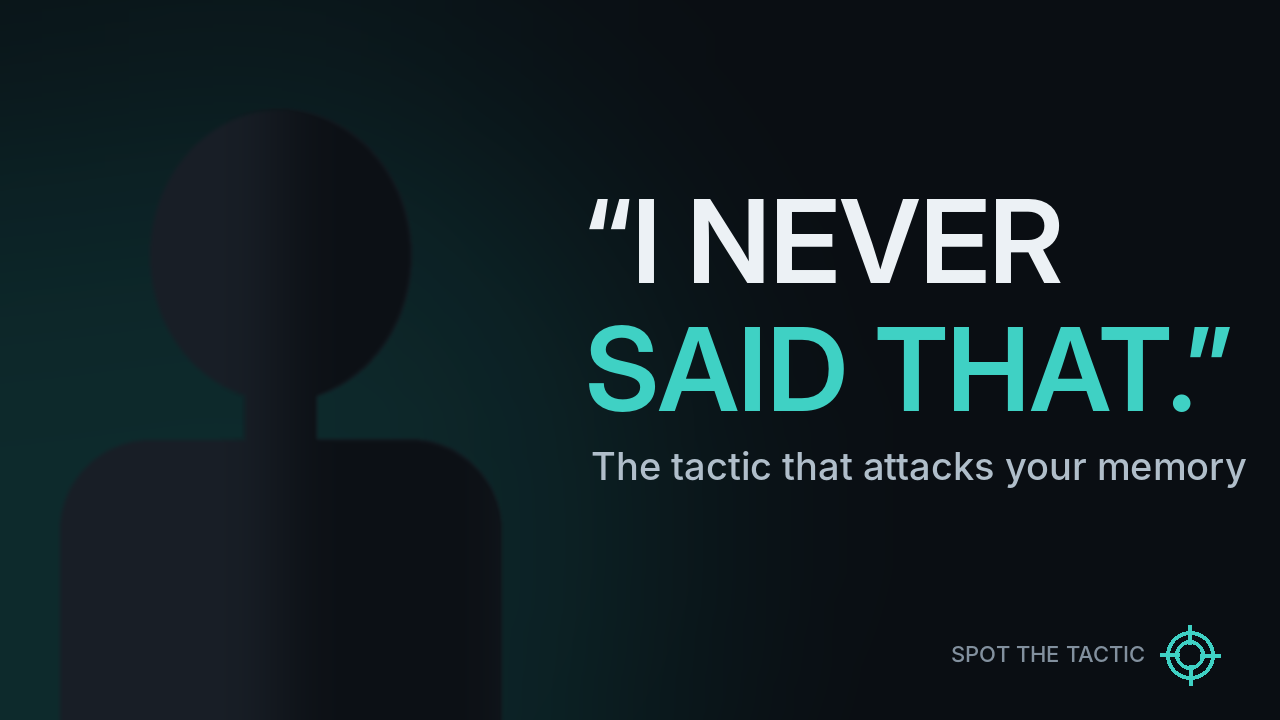
“I never said that.”

You say

“You did. Tuesday. In the kitchen.”

They say

“Are you sure you're remembering it right?”

Can you spot the tactic?

One manipulation tactic per episode. How it works, what it looks like at work, in a relationship and in a sale, and the defences that hold up in practice.

Episodes

Eight to ten minutes each. New episode every week.

Episode 1 thumbnail: a silhouette beside the words “I never said that.”

Episode 1 · Gaslighting · 8 min

Why you apologise after conversations you didn't start

Gaslighting doesn't argue with your conclusion. It argues with your ability to reach one. Why it works on careful people, three markers that separate it from an honest disagreement, and four defences.

Episode 2 · Flattery · coming soon

Why you say yes right after being praised

A compliment by itself is not a tactic. Praise that arrives to make the next request easier is. Reciprocity, identity and timing, with love bombing and the sales version, plus what to do if you already said yes.

Field guide

The short version of every episode: how to tell the tactic from ordinary human behaviour, and what to do when it's the tactic.

Gaslighting

Doesn't attack the decision. Attacks the instrument you use to make decisions: your own account of what happened.

Episode 1

Three markers

  • RepetitionIt happens over and over.
  • DirectionThe confusion consistently resolves in the same person's favour.
  • TargetThe conversation keeps moving away from the facts, and toward you.

Two people remembering the same evening differently is not gaslighting. It's being human.

Four defences

  1. Move your memory outside your head. After any verbal agreement that matters, send the short version in writing. Frame it as tidiness, not accusation.
  2. One witness, not a jury. Describe what happened, plainly, to one person outside the situation.
  3. Separate the fact from the feeling. “I might have overreacted. That's a separate question from whether the sentence was said.”
  4. Watch direction, not incidents. Individual incidents are always deniable. Direction isn't.

Flattery

Praise that arrives in order to make the next request easier. Works best when the compliment is at least partly true.

Episode 2 · coming soon

Three markers

  • TimingIt arrives right before an ask.
  • ShapeIt praises who you are, not what you did.
  • CostSomething you'd normally refuse now feels impossible to refuse.

Most praise is sincere. Suspecting everyone who is kind to you is the wrong lesson.

Four defences

  1. Separate the compliment from the request. “Thank you, that means a lot. I can't do the weekend.”
  2. Buy time. Reciprocity pressure fades fast. “Let me check and get back to you” is a complete sentence.
  3. Refuse the identity contract. Answer the task, not the label. You can keep the compliment and still decline the job.
  4. Keep a ledger. One compliment before a request is nothing. Five is a pattern.

About

Spot the Tactic is about recognition, not diagnosis. Every episode takes one tactic people use to influence each other, shows it in three ordinary rooms, and gives you defences you can use without deciding what kind of person you're dealing with.

The scripts are original and written for this channel. Narration is AI-generated. Nothing here is clinical advice; if a situation in your life is more than a conversation you can walk away from, talk to someone qualified.

The question each episode asks is the one the tactic depends on you never asking: what is this sentence for?

Questions, corrections, or a tactic you'd like covered: spotthetactic@gmail.com